| 
[ Information
| Background
| The CyberTeaser
| Quantum News
| Miscellaneous Stuff
]
Contents of the March/April 1996 issue of Quantum
Feature articles
From the Edge of the Universe to Tartarus
by Albert Stasenko
The Greek poet Hesiod had a theory of how big the universe is: it would take an anvil
nine days to fall from the heavens to the Earth, and another nine days for it to fall to
the bottom of Tartarus (the underworld). How would a modern physicist go about checking
the ancient poet’s numbers?
Construction Program
by Alexander Kirillov
On March 31, 1795, the great mathematician Carl Friedrich Gauss constructed the regular
17-gon and was so impressed that he embarked on a mathematical career. Later Gauss proved
the constructibility of regular n-gons for all numbers n that are
“Fermat primes.” The author heads in the other direction and explains why
regular polygons are constructible only for such values of n.
From Mouse to Elephant
by Anatoly Mineyev
It’s amazing, in a way, that the shrew and the whale belong to the same biological
family. In addition to sharing some obvious traits, all mammals have certain subtle
characteristics in common. This article attempts to answer two simple questions: Why is
the average diameter of a mammalian cell the value that it is? And why is it approximately
the same for all mammals, even though their masses differ tremendously?
How Many Divisors Does a Number Have?
by Boris Kotlyar
The Divisor Problem is one of the most interesting problems in number theory. Starting
from his initial question (posed in the title), the author touches on the hyperbola,
integer points on the plane, integration, and the natural logarithm, tying them together
rather unexpectedly.
 Departments Departments
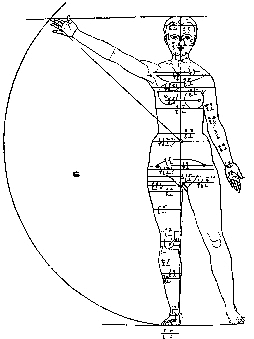
Kaleidoscope: The Long and Short of It
“Length” is one of the first geometric notions we encounter. It seems rather
simple and straightforward—almost primitive. But investigations of length have led to
some important mathematical concepts that are far from obvious and far-reaching in their
consequences. (Click here to see an “ancient”
instrument mentioned in this article (and in the Toy Store as well) but not depicted in
the printed magazine.)
Mathematical Surprises: The Golden Ratio in Baseball
by Dave Trautman
The famed Fibonacci sequence finds application in that favorite sport of statisticians
and the statistically minded.
Sticking Points: Surprises of Conversion
by I. Kushnir
Flip a theorem on its head, it’s still basically the same thing, right? Wrong.
Sometimes it’s harder that it seems to prove the converse of a theorem.
At the Blackboard I: A Gripping Story
by Alexey Chernoutsan
Six cases of static friction are presented, with an explanation of how to slide past
them.
In the Lab: Up the Down Incline
by Alexander Mitrofanov
The strange behavior of a double-cone roller—it goes up, when it
“should” go down!
Physics Contest: Sea Sounds
by Arthur Eisenkraft and Larry D. Kirkpatrick
Readers are invited to solve a problem from the XXVI International Physics Olympiad,
held in Canberra, Australia, in July 1995.
Math Investigations: The Orbit of Triangles
by George Berzsenyi
A short sequence of operations, repeated a thousand times or so, produces a
“butterfly wing,” which readers are invited to investigate further.
In Your Head: Number Show
by Ivan Depman and Naum Vilenkin
Learn some nifty number tricks that will confound your friends and won’t lose
their charm even after you “let the cat out of the bag.”
At the Blackboard II: So What’s the Point?
by Gary Haardeng-Pedersen
The author offers a way of replacing algebraic solutions to vector problems with
geometric ones that may actually provide a better understanding of the physics involved.
Toy Store: Nesting Puzzles (part 2)
by Vladimir Dubrovsky
This article picks up where part 1 left off (in the January/February issue), presenting
two new puzzles and a method of solving them.
How Do You Figure?: Challenges in Physics and Math
Brainteasers: Just for the Fun of It!
Check out this sample!
Happenings
Crisscross Science
Scientific crossword puzzle.
Answers, Hints & Solutions
 Quantum Control Panel Quantum Control Panel
Information | Background | The CyberTeaser | Quantum News | Miscellaneous Stuff
Copyright 1996 © National
Science Teachers Association
All rights reserved
|