|
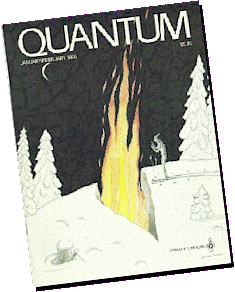
[ Information | Background | The CyberTeaser | Quantum News | Miscellaneous Stuff ] Quantum: The Magazine of Math and ScienceWhat is Quantum?Quantum, published from 1990 to 2001 by the National Science Teachers Association (NSTA), was a lively, handsomely illustrated bimonthly magazine of math and science (primarily physics). In addition to its feature articles, Quantum’s departments included At the Blackboard (the beauty and usefulness of equations), In the Lab (hands-on science), Kaleidoscope (a collection of snippets designed to consolidate your grasp of a given topic), How Do You Figure? (challenging problems in physics and math), Brainteasers (fun problems requiring a minimum of math background), Looking Back (biographical and historical pieces), and Gallery Q (an exploration of links between art and science). Quantum actively engaged the reader, posing questions and pursuing ideas as if they’re brand new (even if they’re a thousand years old). Most Quantum articles included problems for the reader to work through, and each issue contained an answer section. Some articles were elegant expositions of sophisticated concepts, and some gave an unexpected twist to a well-known idea or phenomenon. Others showed that there is no such thing as a silly question. For instance, one article asked: “Why are the holes in Swiss cheese round?” Quantum in effect said: smirk at your own risk—there’s knowledge to be had in such “naive” questions! Who published Quantum?Quantum was published by the National Science Teachers Association (NSTA) and Springer-Verlag New York, Inc. NSTA was responsible for the editorial side of the magazine, and Springer printed and distributed it. NSTA worked closely with Quantum Bureau of the Russian Academy of Sciences in selecting and preparing material, and Quantum’s advisory board consisted of members of the American Association of Physics Teachers (AAPT) and the National Council of Teachers of Mathematics (NCTM). Where did Quantum come from?Quantum came from Kvant , our Russian-language sister magazine. Any given issue of Quantum was not, however, simply a translation of the corresponding issue of Kvant. We used translations of selected articles from Kvant and supplemented them with original material generated in the US. After months of negotiations, the first issue of Quantum appeared in January 1990. Kvant is a journal of math and physics founded in 1970 by two prominent Soviet scientists: the mathematician A. N. Kolmogorov and the physicist I. K. Kikoyin. (Kvant means “quantum” in Russian.) It’s an outgrowth of a Russian educational tradition that encourages top-notch scientists to extend their teaching to high school students and to write challenging but accessible material for them. Kvant helped form an entire generation of Soviet scientists, many of whom wrote for Kvant/Quantum. What kind of stuff will I find in Quantum?You’ll find articles that make you think and articles that make you wonder. You’ll find brainteasers and mathematical amusements. You’ll find articles that teach you tricks of the trade, articles that broaden your sense of the scientific endeavor, and articles that bring classical notions to life. You’ll find challenging problems in physics and math, and you’ll find answers, hints, and solutions in the back of each issue. And you’ll find full-color, thought-provoking artwork by award-winning Russian and American artists. Nominally, our target audience was high school and college students and their teachers. But actually, Quantum was aimed at the student in all of us. If you’re interested in the physical world and enjoy mathematics, Quantum is for you. You may find some things in Quantum hard, some easy, but we guarantee you’ll find something interesting and worthwhile in every issue. Quantum samplerIf you would like to see what Quantum had to offer, you can view an electronic Quantum sampler (approx. 330 KB). This is a Portable Document Format (PDF) file that preserves the appearance of the printed magazine. It requires the Adobe Acrobat Reader, which is available free of charge from Adobe Systems, Inc. Your Web browsing software (Netscape, Internet Explorer, etc.) allows you to configure your browser to automatically load the Reader software and display the PDF file. (Click on the Adobe link above for more details on how to obtain and use the Adobe Acrobat software.)
Copyright © 1995–1998 National Science
Teachers Association |

 Back to the top ...
 Quantum Control Panel